*Please note that this page is under construction. Buttons, links and information are still being added and adjusted. Thank you for your understanding.
Overview
Vocab Ninja! is vocabulary learning app for kids and a progress tracker for their parents so that parents can stop the nagging and kids can get back to having fun all while expanding their lexicons.
My Role
As a former language teacher and mom of two young boys, I wanted to explore creating an app that helped kids with vocabulary learning.
Roles: UX Researcher, Wireframing & Prototyping, Usability Testing Proctor
Duration: One month
Tools: Pen & Paper, Marvel App, Adobe XD
The Challenge
How might we entice, encourage, and empower elementary school-aged children (6-10) to learn new vocabulary on their own thus relieving the stress, frustration and ambiguity of study time for parents and building good study habits for future independent learners.
Potential Solution
A native app that uses gamification to capitalize on kids’ interest in videogames and connecting with their friends to learn new vocabulary.
Parents, guardians and teachers will also be able to check their student’s progress and time on task to assure they are studying.
Inspiration Phase
Competitive Analysis
As a former high school language teacher I am very familiar with vocabulary building apps that my students could use. I was curious to see how they all matched up and specifically what was out there for younger children.
The Long and the Short of It…
During my competitor research, I found that:
- the gamification and peer connection were integral in keeping interest
- cute animations/ images added delight to an otherwise stressful situation
- the discoverability allowed for ease of use even for a child
- the flexibility to add sets and modify them helped tailor the app to the user’s specific study needs.
User Interviews
I spoke with 4 parents of elementary school aged kids from different families about their kids’ study habits and routines, digital practices and abilities, and how they feel around homework time.

Expert Insights
One of the moms that I interviewed was also a Reading Specialist for elementary school children, so I was able to get expert insights into how children learn vocabulary and how the schools are currently teaching it.
Below are a few take aways from our conversation:
- Reading is #1 in vocabulary building- especially non-fiction
- Offer kids a choice of when to do work and schedule it
- Click and read apps are more accessible to kids that struggle
- Spelling games help (e.g. crosswords, word search, etc.)
- “I feel it’s important to focus on the whole child, so building their vocabulary isn’t just good for them academically, but also for their social-emotional lives.“
The General Consensus
Below are few takeaways from the other parent interviews along with my thoughts on ways that Vocab Ninja! could help.
| Takeaways | Insights |
|---|---|
| Kids are frustrated with rote memory drills | Gamification would disguise these drills and encourage intrinsic motivation |
| Parents are frustrated with having to nag their kids all of the time to do their work and study | Allowing kids to schedule their learning and then monitoring kids’ study habits discreetly (i.e. no constant nagging) helps build accountability and independent learners thus helping the whole child |
| Most are very busy and have little time to sit and study traditionally | Having an app that can be used on the go, in the car, at the sibling’s soccer game, or during a quick unexpected free minute |
| Parents give pretest | Keeping track of what words kids have mastered can cut back on excess time spent studying. Question: Is anyone give a post-test? How do we know these words are retained for longterm? |
| Kids use digital content regularly with some restriction (e.g. apps on parent’s phones, iPad, tv, Chromebooks, videogames) | Abilities vary across ages but most have been exposed to some sort of touch screen which is easier to manipulate than a mouse at this age. |
Ideation Phase
Proto-Persona
After collecting all of my research from the inspiration phase I created our proto-persona, Janet- a stay-at-home mom with 3 elementary school aged kids who is frustrated with the constant fights during homework time.

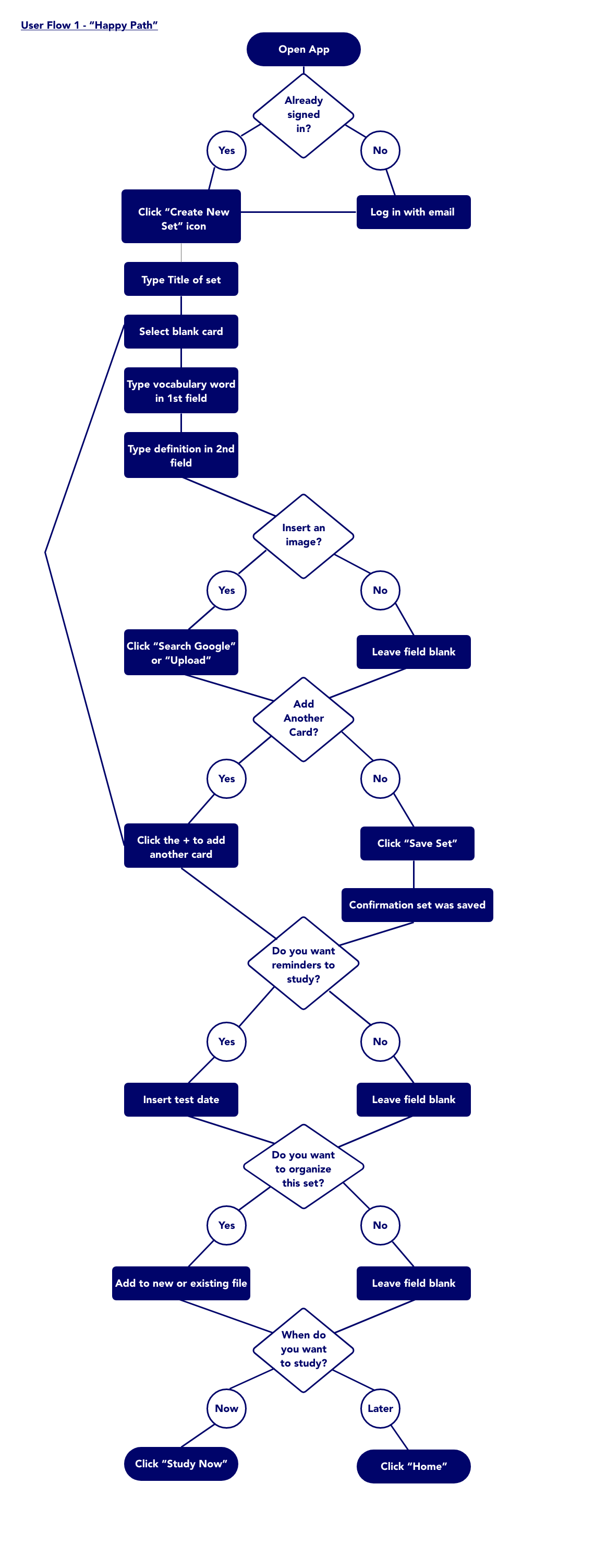
User Flow
 Samantha Uebel